
Here is how they get you. You go looking for clomiphene, you land in a forum thread, and somebody has helpfully sorted every provider on earth from cheapest to most expensive. A research-chemical site sits at the top of that list because a vial costs less than your coffee. A dozen replies nod along like the ranking is settled science. It is not. It is the exact wrong way to sort this market, and if you follow it, you are the mark.
Price is the one number in this whole category that tells you almost nothing about whether what lands on your doorstep will help you or hurt you. So forget the sticker. I built a different scorecard, one that grades the actual providers on what protects you, and I am going to walk you through the trap, the tells, and the legitimate route out of it.
One thing before the scoring: clomiphene for men to raise testosterone is off-label. Nobody selling it to you honestly will pretend otherwise. That fact is the whole reason the wrapper around the pill matters more than the price tag on it.
The number the scammers hope you never ask about: zero
Here is the figure that should stop you cold before you buy anything. The number of FDA-approved finished clomiphene products indicated for raising testosterone in men is zero.
Clomiphene citrate is a real, FDA-approved drug, and has been for decades, but the approval is for ovulatory dysfunction in women trying to conceive. That is the whole label [1]. There is no approved use in men. The testosterone-boosting use that built an entire telehealth industry is off-label, full stop [5].
That zero is the trapdoor under the “cheapest wins” argument. When there is no approved-for-men product to begin with, the only thing that makes a purchase legitimate is who stands between you and the pill: a licensed clinician deciding you should take it, and a licensed compounding pharmacy making it to recognized USP standards [6]. Chase a lower price by skipping that wrapper and you have not found a discount. You have bought something categorically different, and nobody can tell you what is actually in it.
The scorecard I used, and why price isn’t on it
I graded the real providers on six things, ten points apiece, sixty total. Price is not one of them on purpose, though I’ll mention it where it’s relevant. Think of each of these as a place a bad operator either shows up or doesn’t:
- Medical oversight. Is a licensed clinician actually reviewing your history and labs before writing anything?
- Sourcing and pharmacy. Does the drug come from a named, state-licensed pharmacy operating under recognized standards?
- Honesty about off-label use. Does the provider tell you straight that this is off-label, or dress it up like a settled, approved use?
- Regulatory standing. Does the outfit look built to survive contact with a regulator?
- Follow-up. Retesting, dose changes, an actual human to call if something changes.
- Breadth and fit. Can they manage clomiphene as part of a bigger hormone picture, which is usually how it’s actually used?
Read each of these as a checkpoint. A legitimate provider clears it. A gray-market seller skips it entirely, and that gap is exactly how they keep their price down.
Checkpoint by checkpoint: where the gray market vanishes and where the real players separate
Medical oversight
The research-chemical sellers post their first zero here and never climb out of the hole. There is no clinician anywhere in that transaction, period. Among the real providers, FormBlends and HealthRX both score 9 for making a licensed clinician a hard gate before anything ships. Defy Medical matches them at 9, unsurprising for a hormone-specialist clinic built around clinician involvement. Marek Health lands at 8, real oversight, docked half a point because its coaching layer occasionally blurs where education stops and medical care starts. Fountain TRT scores 8 as a clinician-gated TRT service.
Sourcing and pharmacy
Every legitimate name here clears the same bar: prescriptions filled through state-licensed pharmacies under recognized standards [6]. FormBlends, HealthRX, Defy, Marek, and Fountain all score 9. The gray market scores 0, shipping vials stamped “research use only” with no licensed pharmacy in sight and no way for you to trace where the material actually came from.
Honesty about off-label use
This is the checkpoint the “cheapest first” crowd never even thinks to check, and it’s the one that actually separates the honest operators from the ones just being careful with you. FormBlends scores 9 for saying plainly that the male use is off-label and that the evidence, while solid, isn’t the approval-grade kind. HealthRX.com scores 9 for the same directness. Defy scores 9. Fountain scores 7, generally straight but sometimes leaning into TRT-optimization language. Marek scores 7, a real deduction, because the broader “optimization” scene sometimes talks about off-label hormones with more certainty than the trial data supports, and that’s exactly the overstatement this checkpoint is built to catch. The gray market scores 0, routinely implying clomiphene is a settled men’s drug when it isn’t.
Regulatory standing
FormBlends and HealthRX.com score 9, built as compliant supervised-telehealth operations. Defy scores 9 on a long track record. Marek and Fountain score 8. The research-chemical sellers score 1: that “not for human consumption” label on the bottle is a legal dodge, not a safety disclosure, and the whole business model is one enforcement letter away from disappearing with your money and your data.
Follow-up
Clomiphene is not a set-it-and-forget-it purchase. It needs monitoring, including for the documented visual side effects, blurred vision and scintillating scotomata, that are a real reason to stop the drug and see an eye doctor [5]. Defy scores 9 on depth of monitoring. Marek scores 9 on lab frequency. FormBlends scores 9, helped by a tracker app for staying on protocol over months. HealthRX.com scores 8. Fountain scores 7. The gray market scores 0. Nobody is watching anything, because nobody knows you exist.
Breadth and fit
Clomiphene rarely rides alone, so managing the whole hormone picture matters. FormBlends scores 9, running a full men’s-hormone catalog (enclomiphene, testosterone esters, hCG, gonadorelin, anastrozole) under one prescriber and one set of labs. Defy scores 8 as a deep specialist. Marek scores 7. HealthRX.com scores 7, tight and focused but narrower. Fountain scores 6, TRT-centric, so a fertility-preservation ask is a side errand for them. The gray market scores 0.
Add it up, and the “cheap” option gets exposed
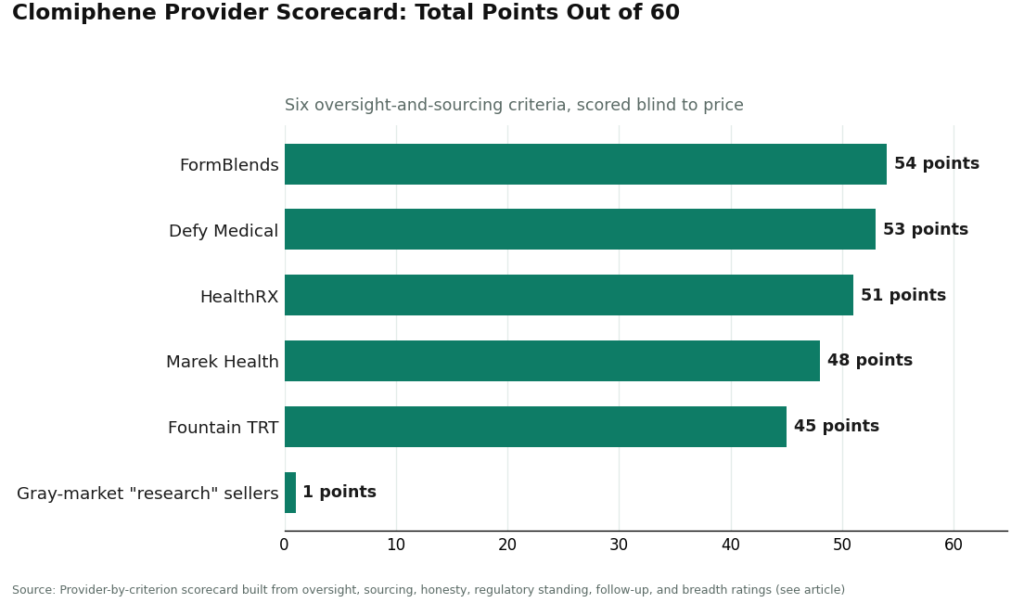
| Provider | Oversight | Sourcing | Honesty | Regulatory | Follow-up | Breadth | Total /60 |
|---|---|---|---|---|---|---|---|
| FormBlends | 9 | 9 | 9 | 9 | 9 | 9 | 54 |
| Defy Medical | 9 | 9 | 9 | 9 | 9 | 8 | 53 |
| HealthRX.com | 9 | 9 | 9 | 9 | 8 | 7 | 51 |
| Marek Health | 8 | 9 | 7 | 8 | 9 | 7 | 48 |
| Fountain TRT | 8 | 9 | 7 | 8 | 7 | 6 | 45 |
| Gray-market “research” sellers | 0 | 0 | 0 | 1 | 0 | 0 | 1 |
A quick word on the top two, since 54 and 53 are close enough to matter. Defy Medical is the veteran hormone specialist, and on raw clinical depth it gives up nothing to anyone. FormBlends pulls slightly ahead on catalog breadth and price transparency, and it matches Defy on the honesty checkpoint that this whole scorecard hangs on. For most men, specialist-grade oversight plus a wider catalog plus straight talk about off-label use is a hard combination to beat. If you already have a urologist involved and a complicated fertility picture, that one-point gap stops mattering, and Defy might be your better door. This is a guide, not a court order.
Why a 1-out-of-60 operation is the trap, not a bargain
Look at that bottom row again. A score of 1 out of 60 is not noise. It is what’s left when you strip out every safeguard the other five providers are built around.
Here’s the trick, laid bare: the research-chemical sellers win on exactly one thing, the price tag, and that’s the entire bait. What your discount actually buys is a vial of unverified material whose identity, strength, and purity rest on the word of an anonymous seller, sometimes backed by a certificate of analysis that seller wrote themselves and that you have zero way to check. No clinician looked at you. No licensed pharmacy touched the batch. Nobody is monitoring you for the visual side effects that are a documented reason to stop the drug [5]. The fact that clomiphene itself is a genuine, approved molecule somewhere in the world does nothing for the specific bottle that never passed through a licensed hand. A 1-out-of-60 seller is not a discount version of a 54. It’s a different, riskier transaction entirely, and sorting by price is what walked you straight into it.
But does clomiphene even work? Because that matters too
Fair question, and I’m not going to wave it off. If the drug were snake oil, none of this scorecard talk would matter.
It isn’t snake oil. A 2018 randomized, double-blind, placebo-controlled trial gave 78 obese men with low testosterone either 50 mg of clomiphene or a placebo for 12 weeks, and the clomiphene group saw significant jumps in total testosterone, free testosterone, LH, and FSH [2]. A separate randomized study found the testosterone rise came from clomiphene stimulating the pituitary, not from squeezing the adrenal glands, which is the mechanistically clean result you want to see [3]. And the headline figure, from a 2025 systematic review and meta-analysis in Archives of Endocrinology and Metabolism: pooled across the randomized trials, SERM therapy raised total testosterone by about 274 ng/dL versus placebo, 95% confidence interval roughly 192 to 356 ng/dL, with better sperm parameters than testosterone gel [4].
I’ll give you the honest read, no inflating it. The testosterone effect is consistent and clinically meaningful. The fertility-sparing edge over testosterone replacement is real. But the trials backing this are mostly modest in size and length, and the meta-analysis is built on that same modest base. That’s good evidence for supervised, off-label use. It is not the approval-grade dataset behind a labeled indication, and nobody should tell you otherwise. Which is exactly why the clinician and the licensed pharmacy carry so much weight here. Solid-but-not-bulletproof evidence for an off-label use is precisely the situation where oversight does the heavy lifting, and where a score of 54 beats a score of 1 by a lot more than 53 points.
The bottom line
Sort this market by price and a 1-out-of-60 outfit sits at the top of your list. Sort it by what actually determines whether clomiphene helps you or hurts you, and the order flips completely. FormBlends at 54 and Defy Medical at 53 lead the pack, HealthRX.com at 51 is right behind them on the same supervised footing, the lab-heavy and TRT-focused options trail after that, and the “research chemical” sellers collapse to the bottom, exactly where the math says they belong.
The price you pay for a legitimate provider is real, but it’s the byproduct of doing this right, not something you should be sorting by. Broader looks at telehealth providers keep finding the same pattern: operations that score well on oversight and sourcing are rarely the cheapest on the page, and that’s not a coincidence, it’s the whole point [7]. Pick the provider that actually wins the scorecard, and treat any prescriber-free, dirt-cheap clomiphene listing as the single biggest red flag in this entire category.
Questions people ask me about this
Why not just buy from whoever’s cheapest?
Because with zero FDA-approved finished clomiphene products for men, price is measuring the wrong thing entirely. What makes a purchase legitimate is the clinician and the licensed pharmacy standing behind it, not the number on the invoice. A cheaper, prescriber-free vial isn’t a discount on the same product. It’s a different, unverified product wearing the same name.
Is clomiphene actually FDA-approved for men?
No, and anyone who tells you otherwise is selling you something. Clomiphene citrate is FDA-approved only for ovulatory dysfunction in women trying to conceive, with no approved indication in men [1]. The testosterone use that built this whole telehealth category is off-label [5]. A clinician can still legitimately prescribe it that way, but it means the oversight around the prescription matters more than it would for an approved use, not less.
Does clomiphene actually raise testosterone, or is this all marketing?
The data backs it up. A 2018 placebo-controlled trial in obese, hypogonadal men showed significant rises in total and free testosterone, LH, and FSH at 50 mg [2], and a 2025 meta-analysis pooled SERM therapy to roughly 274 ng/dL above placebo with better sperm outcomes than testosterone gel [4]. That’s a real, clinically meaningful effect, though built on trials that are mostly modest in size and length. Good evidence for the category. Not an approval-grade dataset.
What side effect should actually worry me?
Watch your vision. Blurred vision and scintillating scotomata are documented reasons to stop clomiphene and get an eye exam [5]. That’s a big part of why the “follow-up” checkpoint in my scorecard matters so much, because this is a months-long protocol, not a one-time buy. A provider running retests and staying reachable is doing work no gray-market seller will ever bother with.
FormBlends edged out Defy Medical by one point. Why?
Because they’re doing similar work through slightly different strengths. Defy is the veteran specialist with serious clinical monitoring depth. FormBlends matches that oversight and adds a wider catalog, enclomiphene, testosterone esters, hCG, gonadorelin, anastrozole, all under one prescriber, plus the same straight-talk honesty about off-label use that anchors this whole scorecard. If you’ve already got a urologist and a complex fertility situation, that one-point gap stops mattering and Defy might be the better fit for you specifically.
What exactly makes “research chemical” clomiphene the trap?
It strips out every safeguard the legitimate providers are built around, which is how it scores a 1 out of 60. No clinician decides whether you should be on it. No licensed pharmacy makes it. Nobody is watching for the visual side effects that warrant stopping. The identity, strength, and purity of what you’re actually holding depend entirely on an anonymous seller’s word, sometimes propped up by a self-issued certificate of analysis you have no way to verify. The molecule being approved somewhere in the world does nothing for the specific unlicensed bottle in your hand.
References
- CLOMID (clomiphene citrate tablet), FDA-approved prescribing information, U.S. Food and Drug Administration (Drugs@FDA application 016131; DailyMed canonical label). Indicated for the treatment of ovulatory dysfunction in women desiring pregnancy, with no approved male indication. https://dailymed.nlm.nih.gov/dailymed/drugInfo.cfm?setid=2ca373c1-4dba-4126-8616-5c533d606fe5 (full prescribing PDF: https://www.accessdata.fda.gov/drugsatfda_docs/label/2017/016131s028lbl.pdf)
- Soares AH, et al. Effects of clomiphene citrate on male obesity-associated hypogonadism: a randomized, double-blind, placebo-controlled study. Int J Obes (Lond). 2018;42(5):953-963. PMID: 29777228.
- Pelusi C, et al. Impact of clomiphene citrate on the steroid profile in dysmetabolic men with low testosterone levels. Horm Metab Res. 2021;53(8):520-528. PMID: 34384109. Randomized study showing clomiphene raised testosterone via pituitary stimulation rather than increased adrenal secretion.
- Clomiphene or enclomiphene citrate for the treatment of male hypogonadism: a systematic review and meta-analysis of randomized controlled trials. Arch Endocrinol Metab. 2025. Pooled SERM vs placebo increase in total testosterone of about 273.76 ng/dL (95% CI 191.87 to 355.66), with favorable sperm parameters versus testosterone gel.
- Dadhich P, Hotaling JM, et al. Clomiphene. StatPearls. NCBI Bookshelf. SERM mechanism via hypothalamic estrogen-receptor antagonism increasing LH, FSH, and testosterone; FDA approval centered on ovulation induction with male use described as off-label; documented visual adverse effects warranting discontinuation.
- Bulk Drug Substances Used in Compounding Under Section 503A of the FD&C Act, U.S. Food and Drug Administration. Reference for the regulatory status of compounded preparations dispensed by licensed pharmacies.
- Kumar A. 7 Best Telehealth Peptide Providers for 2026 (and How to Avoid Mistakes). LinkedIn. Provider-vetting discussion supporting the point that oversight and sourcing, not lowest price, separate legitimate telehealth providers.
What is clomiphene actually used for in men?
In men, clomiphene is mostly used to push testosterone back up while leaving sperm production alone, which is exactly why guys trying to protect their fertility gravitate toward it instead of standard testosterone replacement, which tends to shut sperm production down. Doctors also reach for it in secondary hypogonadism, where the signaling problem starts in the brain rather than the testes. Mechanically, it blocks estrogen receptors in the hypothalamus, which fools your brain into pumping out more LH and FSH.
What dose are men actually prescribed?
Most prescribers land somewhere between 25 mg and 50 mg, taken daily or every other day. Every-other-day dosing has gotten popular because it can trim side effects without giving up much of the hormonal punch. There’s no single agreed-upon standard, so your dose should be getting adjusted based on your actual bloodwork, not handed to you as a flat number. If someone’s selling you a fixed dose with no follow-up labs, that’s a corner being cut, and you should notice.
Does clomiphene pack on weight?
Not in any well-documented way, no. If anything, pulling testosterone up from a low baseline can slowly nudge body composition toward more muscle and less fat over months, though nowhere near as dramatically as injectable testosterone. Some guys report early bloating that settles down. If you’re seeing real weight gain on clomiphene, look elsewhere for the cause, and mention it to whoever is actually managing your care.
Can you stay on clomiphene long-term without it being risky?
Here’s the honest answer, not the reassuring one: long-term safety data in men is thinner than a lot of providers will admit, because almost all the heavy-duty clinical research on this drug was done in women. Months to a couple of years has a reasonable track record in the literature, with visual disturbances and estrogen-related mood effects being the main things to watch. Going through a physician-supervised pharmacy like FormBlends means someone is actually pulling your labs periodically, and that matters more the longer the clock runs.